

FOGGY NOTIONS PRESENTS
NICK HAKIM
WORKMAN'S CLUB
30TH OCTOBER
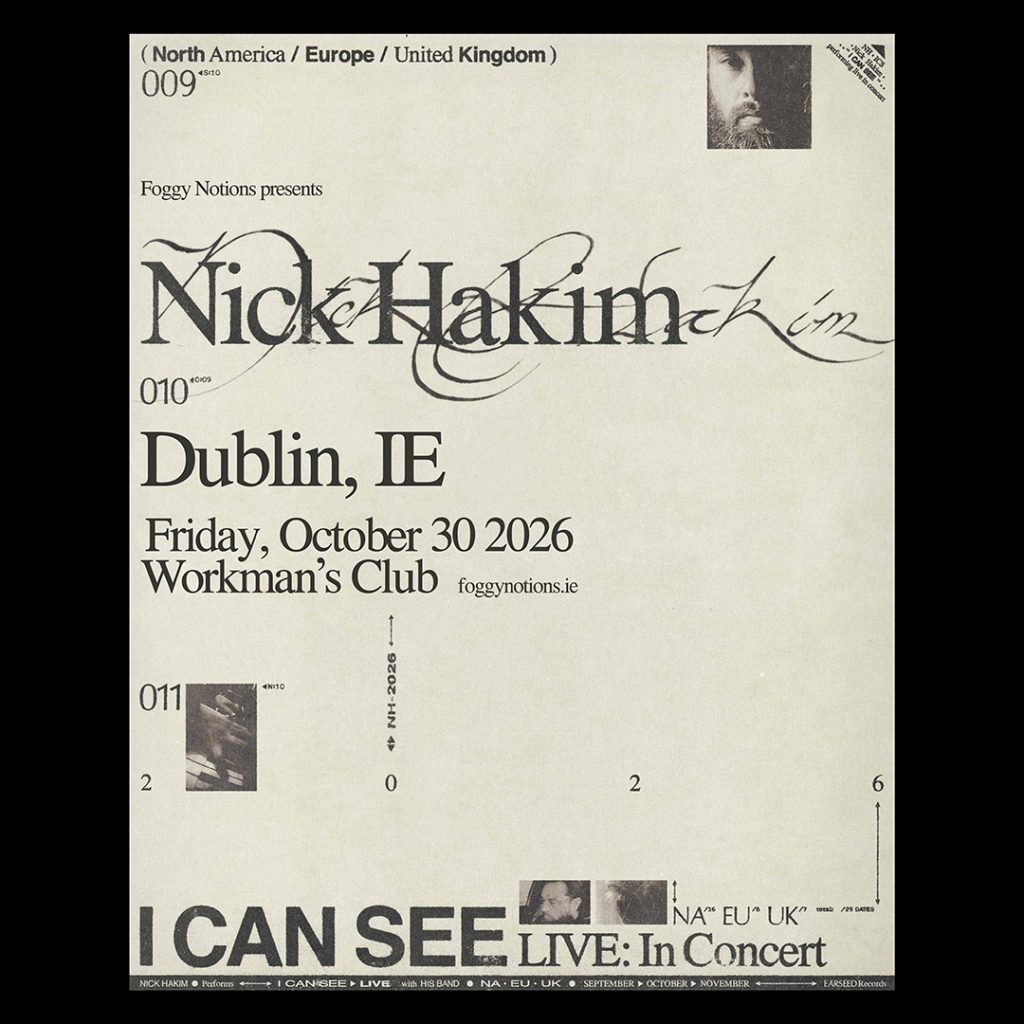
Foggy Notions are proud to present Nick Hakim live at Workman’s Club on Friday 30th October. Tickets on general sale Friday 12th June at 10:00.
NICK HAKIM – I CAN SEE
Nick Hakim sits somewhere between an analytical philosopher, mystic poet, and abstract painter. To hear him speak of music is to encounter someone who fully understands its power, who has been moved by its magic and seen its miracles. He’s devoted to music as both an ancient artform and eternal medicine. To hear him play music is to feel these truisms in live time. It’s a spirit that the New York-based songwriter has carried in his music—both as composer and collaborator. From early LPs like 2017’s Green Twins and 2020’s Will This Make Me Good, to his new album, I Can See, Hakim has pursued the truth in every note he’s written, every lyric he’s sung. His truth, though, is more akin to the abstract and intangible than the factual—more Borges than George Washington. It’s a cosmic assuredness that manifests throughout I Can See; a belief that the good in the universe is good for a reason.
There’s a song on I Can See that offers insight into the way Hakim wrote, imagined, and recorded the album. “Real Here Now” tells the story of a house. It’s a house not dissimilar from the one Hakim grew up in, but in this domicile, he can interact with family members who have since left this realm. It’s a lo-fi subdued soul-pop jam and features some of Hakim’s most direct lyricism to date: “Haven’t seen you in a minute, I’m good,” he begins. In describing the composition, Hakim refers to the “feeling of a song,” how he wanted “Real Here Now” to exist as a nostalgic reminder of the feeling he has when imagining this space; a place in which those who have left find their voices again. “It’s connected to hearing someone sing songs you used to always hear. Now, you just a have a memory of them.” How sweet it would be to hear them just one more time, Hakim expresses on the song.
Like almost all of I Can See, “Real Here Now” was recorded during the same time as Hakim’s last LP, 2022’s Cometa, but it exists in an entirely different universe than the one in which that project rests. It also, to a certain extent, exists in a different world than some of I Can See. Half of the album was recorded at Sonic Ranch in Texas, and the other half was pieced together in Hakim’s New York apartment. Both sessions took place during the pandemic, and as such, I Can See is a living, breathing reaction to Hakim’s shifting space in the world. It’s an image of an artist coming to terms with their reality, captured in such a way that it reveals new angles with each subsequent viewing—or, in our case, each subsequent listen.
Though these songs are older and they represent an uncertain period in Hakim’s life—when he was finishing up a record deal, forming the world of Cometa, and getting out of an extended relationship—I Can See is defined by its clarity. It’s a sharpness alluded to in the title, like feeling a car rattle as it amplifies potent low end or sitting in a hot tub in zero degree weather. “This record felt very cohesive from the beginning. It felt very precious to me and the tricky thing was figuring out what songs to put on the record,” he explains. He arrived at Sonic Ranch with about 40 demos and began picking out which ideas would make it onto the LP. Some of the songs on the album, like “Real Here Now,” are presented as faithful iterations of those first sketches. It lends the album a tactileness, an emphasis on dynamics that is enhanced by this duality.
Take album closer “Water,” which was recorded at Sonic Ranch. It’s a piano ballad in which the songwriter implores his subject to “keep watering,” alluding to, “Being so grateful for someone that is nurturing.” He sings of “the sweetest love” he’s “ever known,” accented by the ghostly rattling of a barely-there synth. It’s presented without the buzzes and room tone that courses through the home recording songs, and it hits like a punch in the gut.
It’s a song about knowing love exists, and how that feeling is almost as good as the love itself; it’s a comfort in the fact that such pureness can exist in the universe. He is satisfied to capture this as well as he can, knowing that the power of love lies in its ability to elude proper definition. He wrote the song after getting out of that long relationship, and it’s only from this perspective that he could sing of the concept in this way, untethered from experience and free from heartbreak. “The sweetest love one could know might be far away, but it’s always there,” he explains.
I Can See is a defining statement from an artist who has yet to put out a record that is anything but. And yet, Nick Hakim’s fourth solo LP is a different experience than his previous efforts. It’s bolder, stronger, more confident. Hakim is more intimately attuned to his vision, and there’s not a note on the album that’s out of place. Nick Hakim might shudder at anyone calling him a healer, but this is certainly music for healing, for taking a breath and facing the world with confidence, lucidity, and joy. “There’s something very gentle and very medicinal about this music. Obviously, we all want our music to be heard by people, but I have a different intention with this record,” he explains, before adding: “The intention is for it to connect with people that need it.”
Written by Will Schube
LISTEN NOW