

FOGGY NOTIONS PRESENTS
THE TALLEST MAN ON EARTH
NATIONAL CONCERT HALL
26TH AUGUST
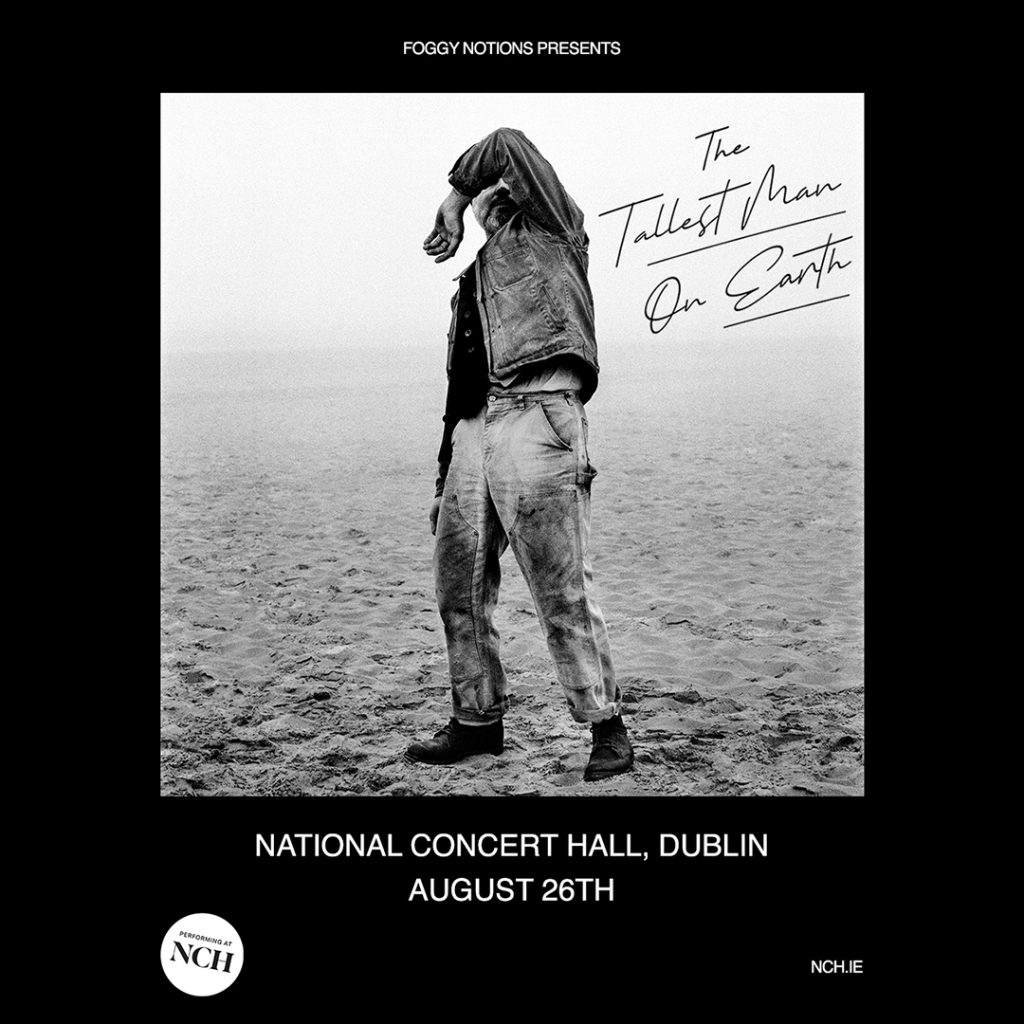
Tickets on now.
THE TALLEST MAN ON EARTH
‘JUST BEYOND ENDLESS MOUNTAIN’
Out October 9th on ANTI-
For nearly twenty years, Swedish singer-songwriter Kristian Matsson has played his way around the world as The Tallest Man on Earth, carving out a singular place in contemporary folk music. His discography has long been heard through the lens of the American folk tradition. But Just Beyond Endless Mountain, out October 9th on Anti- Records, quietly turns that perspective on its head. After returning to his native Dalarna in central Sweden, Matsson found himself listening to the music he had spent years trying to leave behind: the polskas, the old field recordings and the sounds of the local traditions that had surrounded him since childhood. The result is not a return to the past, but a step into new musical territory. Swedish folk music has reshaped his melodies, his voice, and the way he writes songs.
Dalarna is the place Swedes return to, again and again, to reconnect with their past, for better and for worse. This is where Kristian Matsson grew up during the 1980s and ’90s, surrounded by fiddlers and folk dancers, timber cabins and flower-clad Midsummer poles. It was a culture you absorbed whether you wanted to or not. You learned the dances in school, the music too, and every national holiday was celebrated with folk musicians, traditional dress, and the folk games that had been passed down for generations. As if the landscape itself had internalized the nation’s longing for some primordial refuge—a place to retreat whenever modernity had gone too far and, in the process, taken its own people hostage.
Kristian, however, refused to be captured so easily. He started indie bands, hurled himself across the stage like Iggy Pop, and spent his winters snowboarding instead. Then Bob Dylan opened a window, and Matsson traced the music back to its source — to the scratchy field recordings Dylan himself had drawn from at the beginning of it all. Another tradition set Matsson free, though perhaps, in the end, it was the same tradition wearing different clothes.
Matsson’s father died in 2024 after several years living with Alzheimer’s disease. In the months that followed, it was as if the memories of who he had once been slowly returned, after the long, exhausting years of confusion. “The album started out in such a dark place,” Matsson explained. “”But my dad wouldn’t have wanted me walking around feeling sorry for myself. He’s always been the one who believed in me. I figured, okay, now I’m going to make something I really mean — for [my father’s] sake.”
Looking back, the different chapters of Matsson’s career fell into place. His teenage love of unruly rock gave way to an obsession with American blues and folk music. Then came the breakthrough: extensive tours, festival stages, steadily growing audiences, increasingly ambitious recordings, the move to America, and the constant pendulum swing between performing alone and wanting a full band beside him, both onstage and in the studio. Twenty wild years have passed since he released his first EP.
But something changed when he finally stopped moving. A new chapter began. Dalarna became home in the truest sense. Matsson’s farm became his fortress, and the home studio, that had sometimes stood silent, once again became a place where inspiration could rush in—and where freedom opened new windows. He started a garden, bought shares in a few horses, and picked up an ATV to clear the snow from his driveway. And then he bought even more instruments. The fiddle — an instrument he’d had a complicated relationship with since childhood — found its way back into his life. He picked it up hesitantly, but soon became obsessed. Now, he opens his concerts with a polska by Pål Olle of Östbjörka.
“I just wasn’t educated enough in the folk music tradition. I knew so little about it. Somewhere along the way I’d developed this immature aversion to the whole cultural inheritance I grew up with. But now I live here again. I’ve read an incredible amount—not just about the music, but about how people actually lived in the old days. I think that’s part of why this record feels more like me than anything I’ve made before. This album really comes from somewhere.”
Swedish folk music takes many forms. There’s the polished, crowd-pleasing version. And then there are the old fiddlers whose music survives on weathered field recordings — recordings that are, in fact, strangely reminiscent of the old American songs preserved in the Smithsonian archives. That’s where you’ll find the polskas, with their lopsided triple meter and melodies that drift effortlessly between major and minor.
“Those field recordings have made me less afraid,” Matsson said. “People play too fast, out of tune, or in these really strange ways. But sometimes they’re out of tune in exactly the right way. They’ve made me brave enough to be more dynamic — to whisper, to scream, to let things be ugly.”
He’s bought more fiddles. And old reel-to-reel tape machines. The growing collection of instruments — and the aging technology itself — has become part of his creative process. Whenever he loses focus, he can spend an afternoon repairing a tape machine, and by the time it’s working again, the inspiration has usually returned.
Recording at home again has been a liberation. Just Beyond Endless Mountain was allowed to take its time. “I almost think of this as a companion record to [2012’s] There’s No Leaving Now,” Matsson reflected. “They’re most alike in the way they came into being, and in the way they feel to me. I genuinely loved the whole process.”
He’s still singing about what he sees around him—the rivers, the forests, the birds, and the doubt that still catches up with him from time to time. However, the influence of Swedish folk music on Just Beyond Endless Mountain is unmistakable—at least if you know what to listen for. “More than anything, it’s the melodies that have changed,” Matsson said. “A lot of them come from fiddle phrases. They’re so beautiful. This album wouldn’t sound the way it does if I hadn’t been listening to Swedish folk music. It rewired something inside me.”
In the studio, he’s joined by singer Sofia HK and drummer Björn Sima. Most of the fiddle parts and piano overdubs on the album were performed by Martin Hederos (The Soundtrack of Our Lives, Hederosgruppen). CJ Camerieri (Bon Iver, yMusic, Paul Simon) flew in from Los Angeles to record the horn arrangements. Apart from that, Matsson handled almost everything himself, from recording to mixing. “I ran a lot of the tracks through old reel-to-reel tape machines,” Matsson explained. “I use tapes with different amounts of wear, and sometimes I’ve literally held my finger against the tape head just to make everything wobble. The vocals went through an old Nagra, which gives them this beautiful distortion.”
There’s something about where we are now with technology and AI. It’s never been so easy to make a record that sounds perfect. Weirdly, that gives Kristian Matsson a sense of freedom. The Tallest Man on Earth is back with his most deeply rooted album to date. Just Beyond Endless Mountains opens an unexpected new chapter in a career that has never settled for familiar ground.
LISTEN NOW